

Welcome to the first of a three-part rabbit hole. I’ve been reading a book on ‘paracoustics’, or sound and the paranormal, to see what people really think about aural experiences while ghost hunting. While a lot of that talks about vibrations of physical matter, such as infrasound, poltergeist ‘raps’, and telephone messages, it got me thinking about vibrations in electromagnetic fields.
Vibrations in the electromagnetic (EM) field and physical matter differ primarily in their need for a medium to pass through, the nature of their vibration, and the speed they travel. EM field vibrations are self-sustaining, massless, transverse waves (think like the waves of the sea that move up and down), that travel at the speed of light without a medium. Physical matter vibrations (mechanical waves like sound) are oscillations of massive particles (atoms, molecules) that require a medium (solid, liquid, or gas) to transport energy.
During my show, I talk about EVPs and radio frequencies, but don’t demonstrate the spectral analysis of those radio waves, so thought this might be a good idea to explore in a practical way you can do at home.
When I demonstrate the ‘Spirit Box’, which audibly scans through the FM channels really quickly, we often hear snippets of broadcasts happening. I perfectly expect to hear either a consonant or vowel from Sara Cox or Greg James as we skip through 88.1 to 90.2 MHz or 97.1 to 99.7 MHz for Radio 2 and Radio 1 respectively. There are also a whole bunch of other stations depending on where you live. Around Birmingham, I found 36 stations, scattered across various transmitters in the region. Some are stronger than others, and depending on the terrain, and the weather, I may be able to hear some of the weaker signals from the south of the region. These are just the ones legally listed, as there are always going to be ‘pirate’ locals who fancy their moment on the airwaves. And these are just the ones on the FM band.
Buy a radio portable today and it’s likely to be FM only, providing you with frequencies between 87.5 and 108.0 MHz. Shop around and you can get a radio that also picks up AM, where you will find frequencies between 0.52 to 1.6 MHz. These are commonly know as ‘medium wave’ (MW) and are often identified using kilohertz rather than megahertz (520.65 to 160.65 kHz). Keep shopping and you will even find a radio that will also pick up ‘shortwave’ (SW), which sit in between these two at 3.2 to 21.8 MHz. Get the right radio and you can get one that lets you listen to ‘longwave’ (LW) radio too. That could include frequencies between 153 and 279 kHz (or 0.153 – 0.279 MHz). Of course, you won’t find much of interest in this last band, but is good for listening for broadcasts that can travel a long way. For instance, Radio 4 broadcast on LW from just one place, Droitwich in the Midlands, yet that signal covers much of the UK… or it will until 26th September 2026, when they will stop broadcasting Radio 4 on LW. (Interestingly, alongside Radio 4 on LW, there is also a signal broadcast that tells your electric meter when to switch over to peak rate or off-peak.)
Then there is SSB, or Single Sideband radio, a highly efficient form of long-range shortwave communication (often transmitting over 4,000 miles). It is widely used in maritime environments for weather reports and emergency communication, as well as by amateur radio operators. This latter hobby is often referred to as ‘Ham’ radio and operated between 7 and 14 MHz. It can be really tricky to tune into these frequencies for them to come through clearly. Then there is Citizens Band (CB) radio, which operates at 27MHz, often used by truckers for two-way communication. Since 2006, anyone in the UK can use CB radio without a licence, whereas to broadcast on much of the rest of the spectrum requires you to be licensed by OFCOM. Just bear that in mind before you go out spending.
Obviously, there are big gaps in these main bands. So what is all the rest filled with? Between 8.3 kHz and 275 GHz all this stuff happens:
- Meteorological aids
- Maritime radionavigation
- Maritime mobile (including distress and calling via DSC)
- Time signals
- Amateur radio
- Aeronautical radionavigation
- Land mobile
- Radiolocation
- Amateur-satellite
- Radio-astronomy
- Mobile satellite (Earth to space)
- Space operation (space to Earth)
- Space research
- Radionavigation-satellite
- Earth exploration-satellite
- Satellite broadcasting
- Inter-satellite comms
Radio frequencies are congested, yet in the context of ghost hunting, there are a lots of different frequencies to roam through in order to hear your alleged ‘class-A EVPs’. Plus, they all need to be scanned in different ways. You can see the limited range available by domestic equipment above. Even using a great ‘world radio’ you may still have to switch the aerial to be able to get the best reception for some bands, then point it in a certain direction, and maybe stand on one leg… hanging out the window… you get the idea.
To tune into the other bands you’ll need to invest. Either way, the chances of your ghost choosing a frequency you happen to be tuned to or scan past is remote. Just covering the frequencies that we’ve mentioned above would involve 274999991700 different frequencies. Some of these will be harmonics of other frequencies too, so will interfere with each other. For instance, A 433 MHz transmitter might produce a 2nd harmonic at 866 MHz and a 3rd harmonic at 1299 MHz, each time weakening in power. Think of how you may sometimes see a double rainbow, although the outer one is barely visible.
In fact, thinking that these harmonics may interfere at higher frequencies makes the job of allocating the frequencies that people can use for various uses, makes for quite the task. If you’re listening to a radio station and hear interference or a very weak signal coming through, you could be either getting a very distant signal or picking up a harmonic of a station being broadcast more clearly further down the bands. All in all, it makes it very unlikely you’ve got an EVP.
The Ghost Link
Rather than delve into the psychology of what you are hearing, I decided to double-down on how we can carry out an examination of the environment and situation we find ourselves in while experiencing something strange while ghost hunting. Remember what I’ve always advocated: when you experience ‘phenomenon X’, you need to design and carry out experiments to prove that it is not caused by reasons ‘A’, ‘B’, ‘C’, etc… Only when they have all been discounted, can you determine that ‘phenomenon X’ is still something you don’t understand.
This is where our ‘spectral analysis’ comes in. Using the Spirit Box you can only hear a single frequency on the radio spectrum at one moment. And that is prone to you mishearing something quite normal and inane. The spectral analyser allows you to see a whole bunch of frequencies at one time. You can see where the radio stations are, and you’ll be able to see something unusual between those stations. If you do hear an EVP on your spirit box, how can our equipment tell us what the source of our EVP signals are? Let’s look at the kit I have, and decide how useful it is. My kit comes in two forms, one very portable, and the other less so.
This post will explore the portable version. I bought a Seesii portable TinySA spectrum analyzer [sic]. Firstly, it is TINY! But that is useful to drop in a pocket while on a vigil. What does it do? Well you can select a range of radio frequencies, and rather than listen to one at a time, you see the frequency and power of what is being broadcast throughout that range. Even better you can set it to display a waterfall of those signals, so you can observe how they change over time. The is an example of the signals on frequencies between 86.0 MHz and 109 MHz over a period of a minute or so.
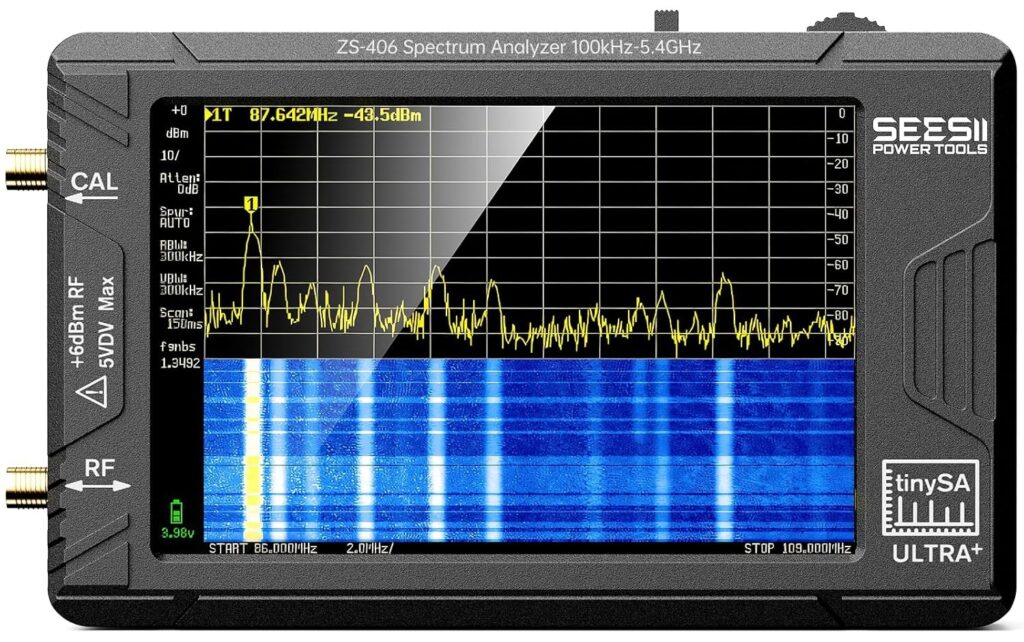
Above you can see the strength of the signals at the top, and you can also see they have been stable over time. Given the frequency range we are looking at, these are likely to be regional radio stations, such as those mentioned at the outset. Assuming that you argue that the EVP you heard is not the voice of one of these stations as you scanned past, but is the voice of a ghost, then you would expect to be able to see the signal appear in-between the stations. You would see a burst of white colour when the communication occurs, that slowly makes its way down the waterfall. If the communication continues then you might want to explore what that could be in more detail. This is where you need a decent radio, like we’ve described above. I got this one:
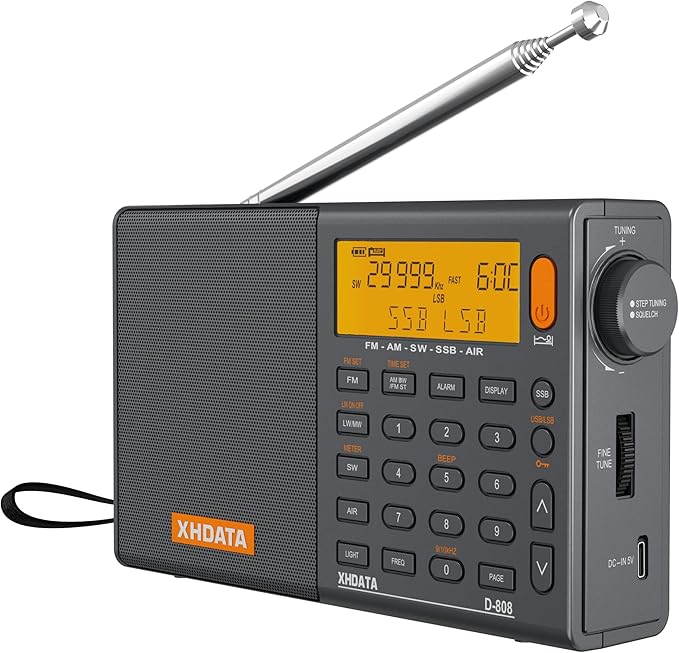
It covers a whole bunch of bands and frequencies including many described earlier:
- LW: 150 to 450 kHz
- MW: 520 to 1710 kHz
- SW: 1711 to 29999 kHz
- FM: 64 to 108 Mhz
- AIR: 118 to 137 MHz
All you need to do is locate the frequency where your EVP appeared as a ‘blob’ on the spectrum analyser and tune your radio to that exact frequency. With a good aerial you may be able to identify what the sound might be. It is likely to be one of those harmonics, or a distant station. Remember that most ‘spirit boxes’ do not come with an aerial for a reason… to make them more ambiguous. Decreasing accuracy and detail, while increasing vagueness and ambiguity flies in the face of science on every level. That’s precisely why my show exists. I’m not saying don’t do it, just do it more thoroughly.
Speaking of which, apart from laying out for this equipment, which should be in the kit bag of anyone intent of using a Spirit Box in anger, is there a way we can use something similar to learn practical skills from? Why yes! I give you the Raspberry Pi!
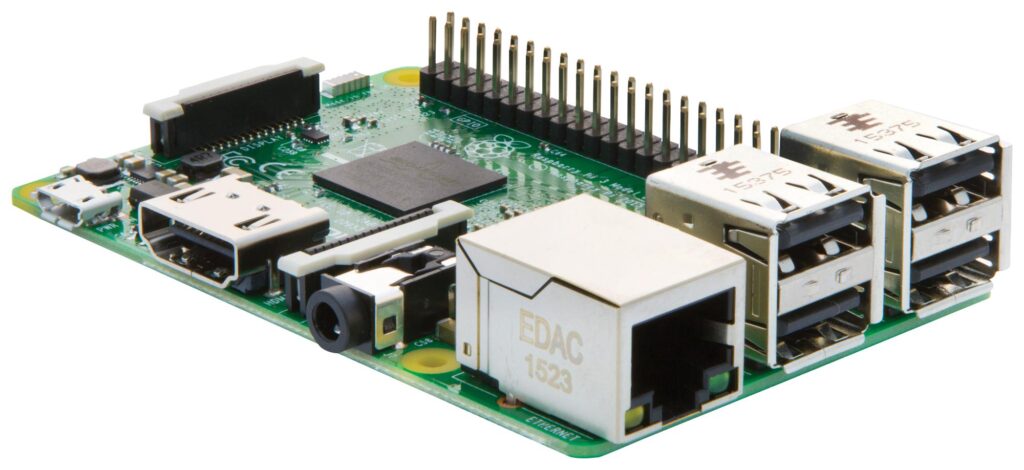
The Raspberry Pi is a single board computer, but more complex and powerful than your Arduino. As such, I’m going to talk about it in the next post. Then finally, I’ll describe how I set up my Pi to run a spectrum analyser. If you have a Raspberry Pi from before, dig it out, dust it off, and get ready to revisit it.
Incidentally, while typing the next post, I came across an interesting artefact while listening to my radio on LW 153 kHz. Every time I pressed a key on my laptop, the radio glitched with interference. It kind of demonstrates just how easy it is to get noise come through a radio.